
Orange County rental property tax planning
Cost Segregation for Rental Properties: When It Helps and What Owners Need to Watch
If you own rental property and someone pitches cost segregation as a way to generate a large first-year write-off, the idea is not wrong. It is just incomplete. The part that matters most is whether the faster depreciation creates a deduction you can actually use now or just a larger passive loss carryforward.
The direct answer: cost segregation can accelerate depreciation on rental property by moving certain assets into shorter recovery periods, but it does not automatically create immediate tax savings for every investor. For many California owners, the real value depends on the passive activity rules, the quality of the study, and how the federal result compares to the California return.
Cost segregation can create a bigger paper loss. The real question is whether that paper loss becomes a current tax benefit.
The strategy is usually about timing, not creating brand-new deductions. If the loss cannot be used currently because the rental activity stays passive, the benefit may be delayed. That is why the passive-versus-active analysis often matters more than the engineering pitch.
Who this is usually most relevant for
Cost segregation tends to pay off when the property and the owner profiles line up. The combinations that come up most often:
- Real estate investors with multiple rentals, recent acquisitions, or significant improvements.
- Short-term rental operators who materially participate (see the seven-day exception below).
- Real estate professionals under the federal test, with current passive income or qualifying active participation.
- Syndication investors with passive income from other rental activities that can absorb new passive losses.
It tends to underdeliver for a single, fully passive rental owned by someone with no other passive income and no plans to add to the portfolio. The cost of a defensible study and the passive-loss limits can quietly absorb most of the benefit. Entity structure can also affect how losses flow through, which we cover in our piece on single-member LLC tax benefits in California.
What cost segregation actually does
Residential rental buildings are generally depreciated over 27.5 years. Cost segregation does not change that rule for the building shell. What it does is separate certain components that should not sit inside one long-life building bucket and place them into shorter recovery periods when the facts support that treatment.
That can include certain personal-property-type assets and certain land improvements. If enough basis moves into shorter-life categories, the owner may get larger deductions in the earlier years through regular MACRS depreciation and, where eligible, bonus depreciation.
The main purpose is not to increase the total amount eventually deducted. The main purpose is to change when those deductions are taken.
Why owners do it
Owners usually pursue cost segregation because earlier deductions can improve near-term planning and cash flow. That is especially relevant when a property was recently acquired, recently improved, or expected to produce enough tax exposure for the faster deductions to matter.
It becomes more attractive when:
- current taxable income is high enough that earlier deductions have real value
- the owner already has passive income from other rentals or similar activities
- the property has enough improvement value and shorter-life components to justify the study cost
- bonus depreciation materially improves the first-year federal result
Current IRS depreciation guidance is part of why the conversation matters right now. Certain qualified property acquired and placed in service after January 19, 2025 may qualify for a 100% special depreciation allowance for federal purposes, which can make a strong federal acceleration story more realistic than it would be in a weaker bonus-depreciation environment.
You don’t always have to do it in year one
Many owners assume cost segregation has to happen the year the property is acquired. It does not. A study can be applied to a property owned for several years through a change in accounting method on Form 3115, with a Section 481(a) catch-up adjustment that pulls all the missed accelerated depreciation into the current year without amending prior returns. For investors who acquired properties before they understood the strategy, this look-back path is often where the most surprising current-year deduction comes from.
Why passive vs. active matters more than most owners expect
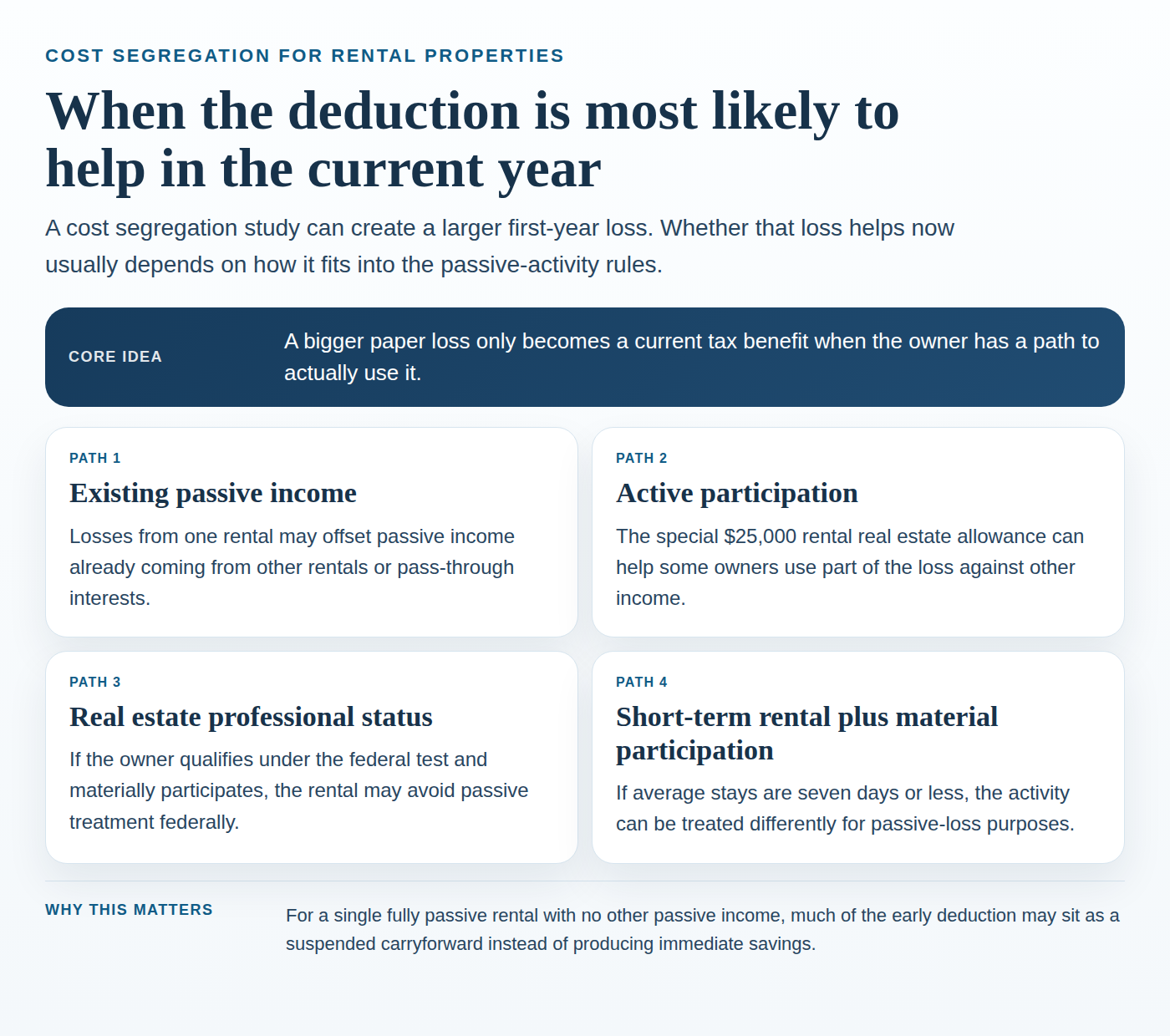
This is where many rental-property articles fall short. Federal tax law generally treats rental real estate as passive, which means accelerated depreciation can create a larger paper loss without necessarily creating an immediate tax benefit.
There are a few common situations where the deduction may still help in the current year:
- you already have passive income from other rentals or pass-through interests
- you actively participate and qualify for the $25,000 special rental real estate loss allowance, which phases out between $100,000 and $150,000 of modified adjusted gross income and is unavailable above $150,000
- you qualify as a real estate professional for federal purposes and materially participate in the activity
If those facts do not apply, the deduction may still matter economically, but part of the value may be deferred as suspended passive losses carried forward.
That does not mean the study was pointless. It means the benefit may arrive later than the marketing pitch suggests.
The short-term rental exception worth knowing
There is a second way to bypass passive treatment that does not require real estate professional status, and it gets overlooked in most cost-segregation marketing. If the average rental period for a property is seven days or less, the IRS does not treat the activity as a rental for passive-loss purposes under Treasury Regulation 1.469-1T(e)(3)(ii). It is treated as a trade or business.
If the owner also materially participates in the activity under the regular IRS standards, the resulting losses, including those amplified by a cost segregation study, can offset other non-passive income such as W-2 or business income. For Airbnb, VRBO, and other short-term rental operators, this is often the deciding factor in whether cost segregation produces a near-term tax benefit or a carryforward.
It still requires real material participation. It requires careful tracking of average rental period and personal involvement. But for the right owner it can change the answer entirely.
For short-term rental owners, the passive-loss math often works differently than it does for traditional landlords.
Faster depreciation, bonus depreciation, and a stronger federal deduction story.
Passive activity limits, California differences, and study quality determine whether the deduction turns into current savings.
IRS Publication 925 is the key reference point here. For real estate professional status, the usual federal threshold is not casual participation. It generally requires more than half of your personal services to be in real property trades or businesses in which you materially participate, plus more than 750 hours of service in those businesses during the year.
When cost segregation tends to make sense
Cost segregation usually gets more compelling when the property profile and the owner profile line up together.
- larger building basis
- meaningful shorter-life assets or site improvements
- deductions likely usable now or soon
- records strong enough to support the reporting
- smaller property where the fee may eat the benefit
- owner likely to remain fully passive with little passive income
- aggressive or weak land allocation support
- thin study quality that would be hard to defend
The quality of the study matters more than many owners realize. IRS cost segregation guidance emphasizes substantiation, qualified analysis, reconciliation to total costs, and proper allocation among land, building, land improvements, and shorter-life property.
What happens on sale: the recapture consideration
Cost segregation has one back-end effect that the marketing usually skips. When a property is sold, depreciation taken on shorter-life property classified into 5, 7, or 15-year categories is recaptured as ordinary income, which can run as high as the top marginal rate of 37 percent. Depreciation taken on the building itself is treated as unrecaptured Section 1250 gain and is capped at 25 percent federally.
In plain terms: cost segregation can shift some of the depreciation that would have been taxed at up to 25 percent on sale into a bucket that is taxed at up to 37 percent. The net economic benefit therefore depends on whether the front-end deductions outweigh the back-end recapture, and on the expected hold period.
For owners who plan to hold long term or who plan to exchange under Section 1031, the math usually still works because recapture is deferred. For shorter holds, this trade-off deserves a closer look in the model before the study is ordered.
California owners need a second review
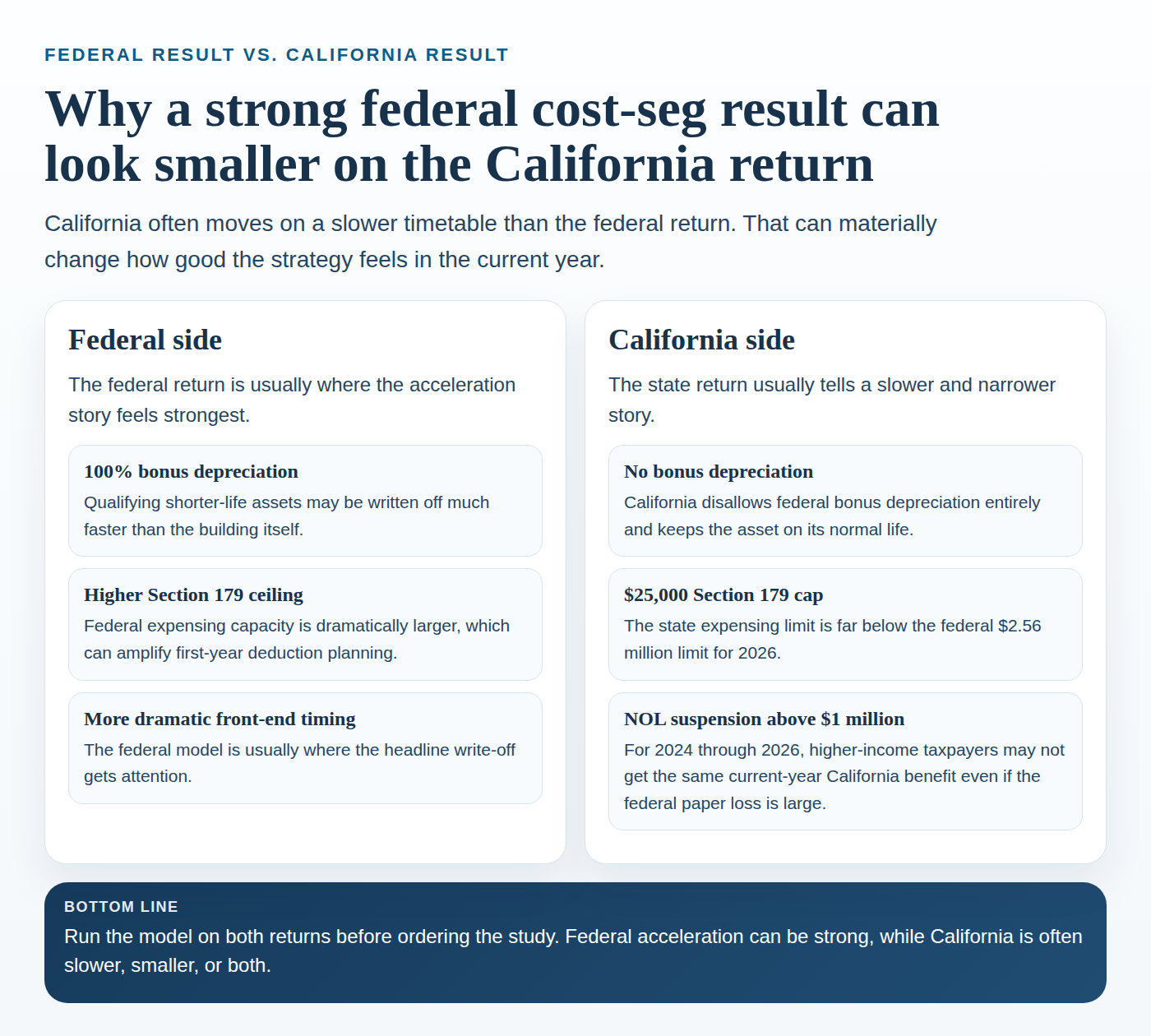
For California owners, the federal result is only half the analysis. The state’s depreciation rules diverge from federal in three ways that matter for cost segregation:
- California disallows federal bonus depreciation entirely. The 100% federal write-off does not appear on the California return at all. The asset is depreciated over its full life on the state side.
- California caps Section 179 expensing at $25,000 for 2026, compared to the federal $2.56 million limit. The federal acceleration story can be dramatic; the California story usually is not.
- For 2024 through 2026, California suspends the use of net operating losses for taxpayers with more than $1 million of taxable income. If a cost segregation study creates a large federal paper loss for a high-income owner, the same numbers may not even produce a current California benefit during the suspension window.
California also treats rental activity differently from the federal real estate professional framework, so an owner who qualifies for current-year use federally may still see a different California outcome. None of this kills the strategy. It does mean the model should be run on both returns before anyone assumes the same savings pattern.
A federal cost-seg win can feel underwhelming in California, where bonus depreciation does not exist and the NOL door is partly closed for high earners through 2026.
What to review before ordering a study
Cost segregation is usually worth discussing before purchase close, during renovation planning, or soon after acquisition, not years later after the records have gone stale.
Before moving forward, an owner should usually review:
- projected federal benefit versus study cost
- projected California result, not just the federal result
- whether the expected losses will be usable now or carried forward
- land allocation and purchase-price support
- whether bonus depreciation materially changes the answer
- expected hold period and future recapture considerations
- whether the provider can produce a detailed, defensible report
The cheapest study is not always the cheapest decision. A weak report with aggressive classifications can create audit risk and disappoint on the back end.
If you are evaluating a rental acquisition, renovation, or broader real estate tax-planning move, Bharmal can model whether cost segregation would create usable tax savings before you pay for the study. Real estate is one part of broader year-end planning; our Orange County Small Business Tax Checklist for 2026 covers the wider context. Schedule a conversation.