
Charitable Contributions for Advanced Tax Planning Strategies
Most charitable giving is handled too late in the year and too casually for the tax result donors expect. Writing checks in December may support the right causes, but it often misses the bigger planning opportunities: donating appreciated assets before a sale, bunching multiple years of gifts into one tax year, using a donor-advised fund, evaluating a private foundation, or coordinating charitable giving with retirement income and estate planning.
For Orange County business owners, executives, real estate investors, and high-income families, charitable contributions should be planned the same way as capital gains, entity income, estimated taxes, and estate transfers. The question is not only “How much should we give?” The better question is “What asset should we give, when should we give it, and what structure should receive it?”
The direct answer: advanced charitable tax planning usually means matching the right giving vehicle to the donor’s income, assets, timing, and control goals. Donor-advised funds are often useful for bunching deductions and donating appreciated publicly traded securities while deciding on grants later. Private foundations can provide more family governance and grantmaking control, but they bring lower deduction limits, administration, excise tax rules, and private foundation compliance. Appreciated asset donations can be more tax-efficient than cash because the donor may avoid capital gains tax while claiming a charitable deduction, but valuation, AGI limits, and documentation rules matter.
Best fit for this article: taxpayers with appreciated stock, concentrated equity positions, business sale planning, real estate gains, large income years, retirement account distributions, or a desire to build a long-term family giving structure.
Main risk: the donor focuses on the deduction but misses the planning order. The strongest charitable strategies usually need to happen before a liquidity event, before year-end, and before the asset is sold.
Planning point: the tax result depends on the type of asset, the recipient organization, the donor’s AGI, whether the donor itemizes, and whether the required substantiation is complete.
Accurate as of Tax Year 2026.
This article covers asset-first charitable planning, AGI limits, donor-advised funds, private foundations, DAF vs. private foundation planning, appreciated asset donations, bunching, qualified charitable distributions, substantiation, California conformity, and frequently asked questions.
1. Start with the asset, not the charity receipt
The simplest charitable contribution is cash. Cash is easy to document and easy for the charity to use. But for a taxpayer with appreciated investments or a pending sale, cash is not always the most tax-efficient asset to give.
If a taxpayer sells appreciated stock, pays the capital gains tax, and then donates cash, the charitable deduction may help but the capital gain has already been triggered. If the taxpayer instead donates long-term appreciated stock directly to a qualified public charity or donor-advised fund, the donor may be able to deduct the fair market value of the asset and avoid recognizing the built-in capital gain.
That is the core of appreciated asset planning. The donor is not only making a charitable gift. The donor is deciding which asset should leave the balance sheet.
This planning can be especially valuable when a portfolio has a concentrated position, a founder has low-basis shares, a real estate investor is considering a sale, or a business owner expects a high-income year.
2. Know the main AGI limits before choosing the vehicle
The IRS charitable contribution rules use percentage limits tied to adjusted gross income. The exact limit depends on the type of property and the type of recipient organization.
For many individual taxpayers, cash gifts to public charities can be deductible up to 60% of AGI. Noncash gifts, gifts of appreciated capital gain property, and gifts to certain private foundations can have lower limits, commonly 50%, 30%, or 20% depending on the facts.
The practical lesson is simple: two gifts of the same dollar value can produce different current-year deductions depending on what was donated and where it was donated.
For 2026 and later, charitable planning also needs to account for newer federal rules that can reduce the current-year benefit. Non-itemizers can deduct up to $1,000 for single filers or $2,000 for married couples filing jointly for qualifying cash gifts, but gifts to donor-advised funds and certain private foundations generally do not qualify. Itemizers must clear a 0.5% of AGI floor before charitable gifts produce a federal itemized deduction. For example, if AGI is $400,000, the first $2,000 of otherwise deductible charitable contributions produces no federal itemized deduction. Taxpayers in the top bracket also need to account for the new 35% cap on the value of itemized deductions, meaning a dollar of charitable deduction may be worth no more than 35 cents on the dollar federally.
That does not mean charitable giving is no longer valuable. It means timing and structure matter more.
3. Donor-advised funds work well when timing and flexibility matter
A donor-advised fund is a separately identified charitable account maintained by a sponsoring public charity. The donor contributes assets to the sponsoring organization, the sponsoring organization has legal control over the assets, and the donor retains advisory privileges over future grants.
That structure solves a common planning problem. A donor may need the charitable deduction in a high-income year but may not be ready to decide which charities should receive all of the money immediately. A donor-advised fund can separate the tax contribution year from the later grantmaking schedule.
This is why donor-advised funds often pair well with bunching, which groups several years of giving into one tax year. See the bunching section below for how that works, with a worked example.
Donor-advised funds can also be efficient for publicly traded appreciated securities. Many sponsoring organizations can receive marketable securities, sell them inside the charitable structure, and allow the donor to recommend grants in cash later.
The tradeoff is control. A donor-advised fund is not the donor’s private account. The sponsoring charity owns the assets, and the donor’s role is advisory. For many families, that is an acceptable tradeoff because the structure is comparatively simple. Donors who want more direct control may want to consider a private foundation, covered next.
4. Private foundations offer control, but the tax and compliance cost is real
A private foundation can be useful when a family wants a long-term philanthropic platform, formal governance, family involvement, custom grantmaking, scholarships, program-related investments, or a public identity around giving.
That control comes with rules. Private foundations generally have annual filing requirements, investment income excise tax, minimum distribution requirements, self-dealing restrictions, taxable expenditure rules, and administrative overhead. They also often have less favorable income tax deduction limits than gifts to public charities or donor-advised funds.
For example, a private foundation may be attractive if a family wants children or successors involved in grant decisions. It may be less attractive if the primary goal is simplicity, immediate tax efficiency, or donating complex appreciated assets with a full fair market value deduction.
Self-dealing is a major issue. A private foundation is not a family expense account. Transactions between the foundation and disqualified persons can create excise tax exposure, even when the family believes the arrangement is reasonable. Compensation, leases, loans, use of property, event tickets, travel, and reimbursement arrangements need careful review.
The foundation decision should usually be made after answering three questions: Is the family willing to operate a charitable entity each year? Is the desired control worth the lower flexibility and higher compliance burden? Is the planned contribution large enough to justify the structure?
5. Compare donor-advised funds and private foundations before funding either one
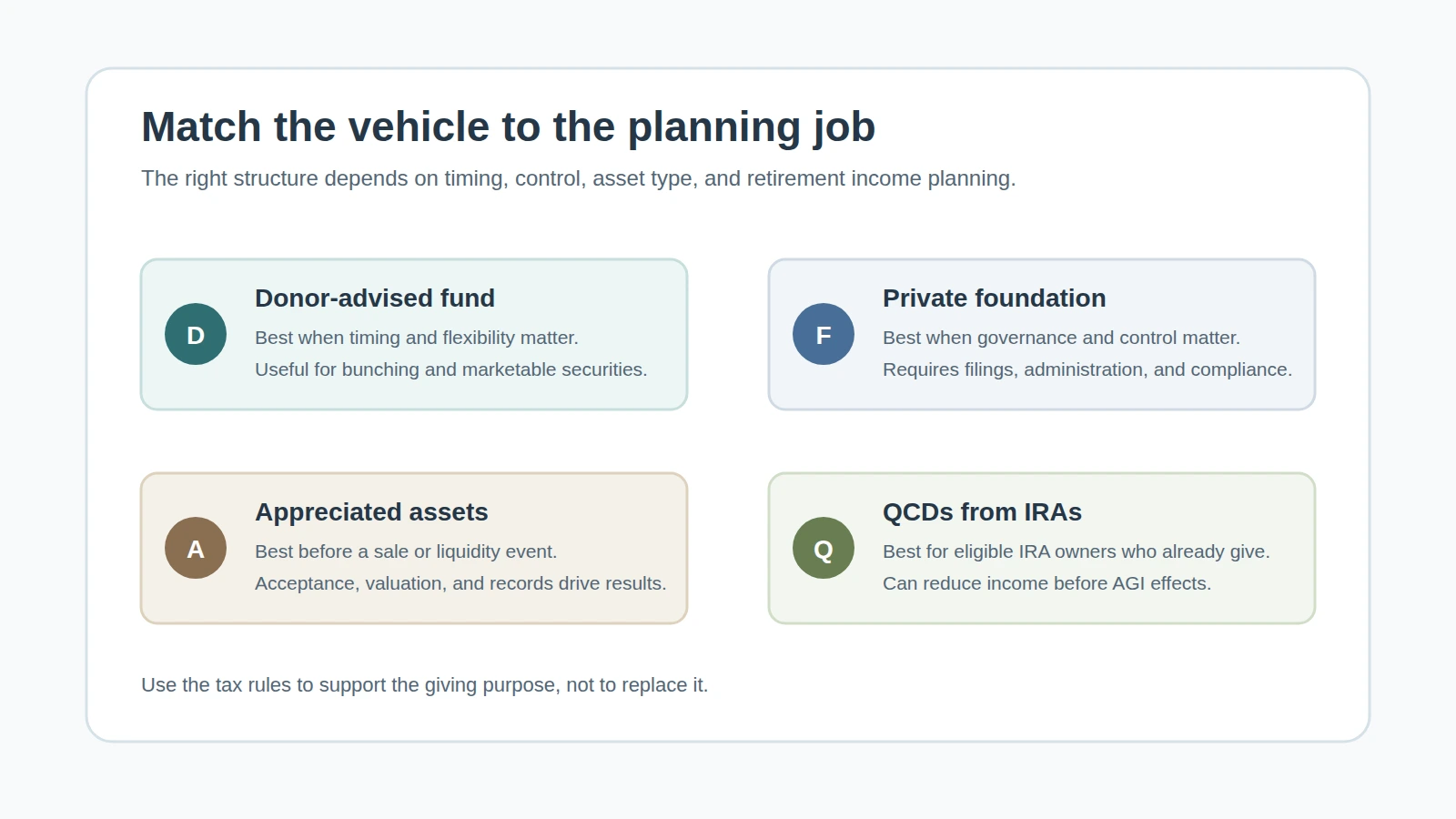
A donor-advised fund is usually the cleaner fit when the main goals are tax timing, simplicity, appreciated marketable securities, and flexible future grants. The sponsoring charity controls the assets, and the donor recommends grants over time.
A private foundation is usually the better fit when the family wants formal governance, long-term control, custom grant programs, or a public philanthropic identity. The foundation controls assets through its board or trustees, but that control brings administration, annual filings, compliance work, investment oversight, and records.
Deduction profile
Donor-advised fund gifts are often treated as gifts to a public charity, subject to the applicable AGI limits. Private foundation gifts often face lower deduction limits, especially for certain appreciated property.
Grantmaking control
Donor-advised fund grantmaking is advisory and subject to sponsor approval. A private foundation gives the family more direct control, but only inside the private foundation rules.
Compliance risk
Donor-advised funds still have rules, but the compliance burden is generally lower. Private foundations carry higher risk around self-dealing, minimum distributions, taxable expenditures, excise taxes, and annual reporting.
The right answer is not always the largest deduction. Some families value simplicity, others value governance and continuity, and the plan should follow that choice.
6. Appreciated asset donations can do more than cash
Appreciated asset donations are often the center of advanced charitable planning. As noted above, donating an appreciated asset directly can beat selling it first and giving cash. The practical question is which assets work well and which need extra care before a transfer.
Common assets considered for charitable giving include publicly traded securities, mutual fund shares, restricted stock after restrictions are resolved, privately held business interests, real estate, cryptocurrency, artwork, and other collectibles.
Not all assets are equally easy to donate. Publicly traded stock is usually simpler to value and transfer. Real estate, closely held business interests, cryptocurrency, and collectibles require more planning. The charity or donor-advised fund sponsor must be willing to accept the asset, and the donor must handle valuation and reporting correctly.
The order matters. If the asset is already under a binding sale agreement, the IRS may argue the donor effectively assigned sale proceeds instead of donating the asset. In plain English: do not wait until the deal is already locked in and assume a last-minute charitable transfer will work the same way.
The charitable conversation belongs in the same planning meeting as capital gains, estimated taxes, and liquidity strategy, well before any sale is signed.
7. Bunching can restore tax value when annual giving is too small to itemize
Many taxpayers give consistently every year but receive little or no incremental federal tax benefit because they use the standard deduction. Bunching is the strategy of grouping multiple years of charitable contributions into one tax year so the taxpayer may itemize in that year and use the standard deduction in other years.
A donor-advised fund is often used for this because it allows the taxpayer to make a larger charitable contribution in one year while still distributing grants to charities over several years.
For example, a married couple that normally gives $20,000 per year might consider contributing $60,000 or $80,000 to a donor-advised fund in a high-income year, then recommending grants over the next three or four years. The tax result depends on their itemized deductions, AGI, state tax position, mortgage interest, and the new charitable deduction floor for itemizers.
Bunching is not only about tax. It can also make giving more intentional. A family can set an annual charitable budget, fund it during the right tax year, and then make grants without rushing in December.
8. Qualified charitable distributions can be better than itemized deductions for IRA owners
Taxpayers age 70 1/2 or older may be able to make qualified charitable distributions directly from an IRA to eligible charities. For Tax Year 2026, the annual QCD limit is $111,000 per taxpayer. A married couple can potentially transfer up to $222,000 if each spouse has their own IRA and each spouse separately qualifies. A separate one-time QCD limit of $55,000 applies for certain split-interest charitable vehicles, subject to detailed rules. A QCD can satisfy part or all of a required minimum distribution while excluding the transferred amount from taxable income.
This can be stronger than claiming a charitable deduction because it reduces income before AGI-based effects are calculated. That can matter for Social Security taxation, Medicare premium brackets, deduction phaseouts, and the 2026 charitable deduction floor for itemizers. Because a QCD is excluded from income instead of claimed as a deduction, it sidesteps both the 0.5% AGI floor and the 35% itemized deduction cap.
QCDs have restrictions. The transfer generally must go directly from the IRA custodian to the charity. Donor-advised funds and private foundations generally are not eligible QCD recipients. A taxpayer also needs proper acknowledgment from the charity.
For retirees who already give to charity and are taking IRA distributions, QCD planning should usually be reviewed before year-end distributions are processed.
9. Documentation can decide whether the deduction survives
Charitable contribution deductions are documentation-sensitive. A taxpayer can make a real gift and still lose the deduction if the paperwork is incomplete.
For cash gifts, keep bank records, receipts, and written acknowledgments where required. For contributions of $250 or more, the donor generally needs a contemporaneous written acknowledgment from the charity. For quid pro quo contributions over $75, the charity must disclose the value of goods or services provided.
For noncash gifts, the substantiation burden increases. Form 8283 is generally required when total noncash charitable deductions exceed $500. For many noncash gifts over $5,000, the donor may need a qualified appraisal and additional signatures. Publicly traded securities have special valuation rules, but closely held stock, real estate, crypto, artwork, and collectibles require more care.
The most avoidable mistake is treating valuation as an afterthought. If the gift is large or unusual, the appraisal and acceptance process should start before the transfer, not during tax return preparation.
California does not follow the new federal charitable limits
California has not adopted the 2026 federal charitable changes. California generally conforms to the Internal Revenue Code as of January 1, 2025, with specific exceptions, so federal charitable deduction changes enacted after that date do not automatically apply for California income tax purposes.
In practice, the federal rules that shrink a 2026 charitable deduction do not apply the same way on the California return:
- The 0.5% of AGI floor does not apply for California. A gift that loses part of its federal deduction under the floor may still be deductible for California, subject to California’s own rules.
- The 35% cap on the value of itemized deductions for top-bracket taxpayers does not apply for California.
- The federal above-the-line deduction for non-itemizers does not carry to California.
The takeaway for California donors is simple. The federal and state charitable deduction calculations can diverge in 2026. A gift may produce a smaller federal benefit than expected while still producing a different California result.
Accurate as of Tax Year 2026. California updates its conformity date from time to time, so donors should confirm the current state rules before making large gifts.
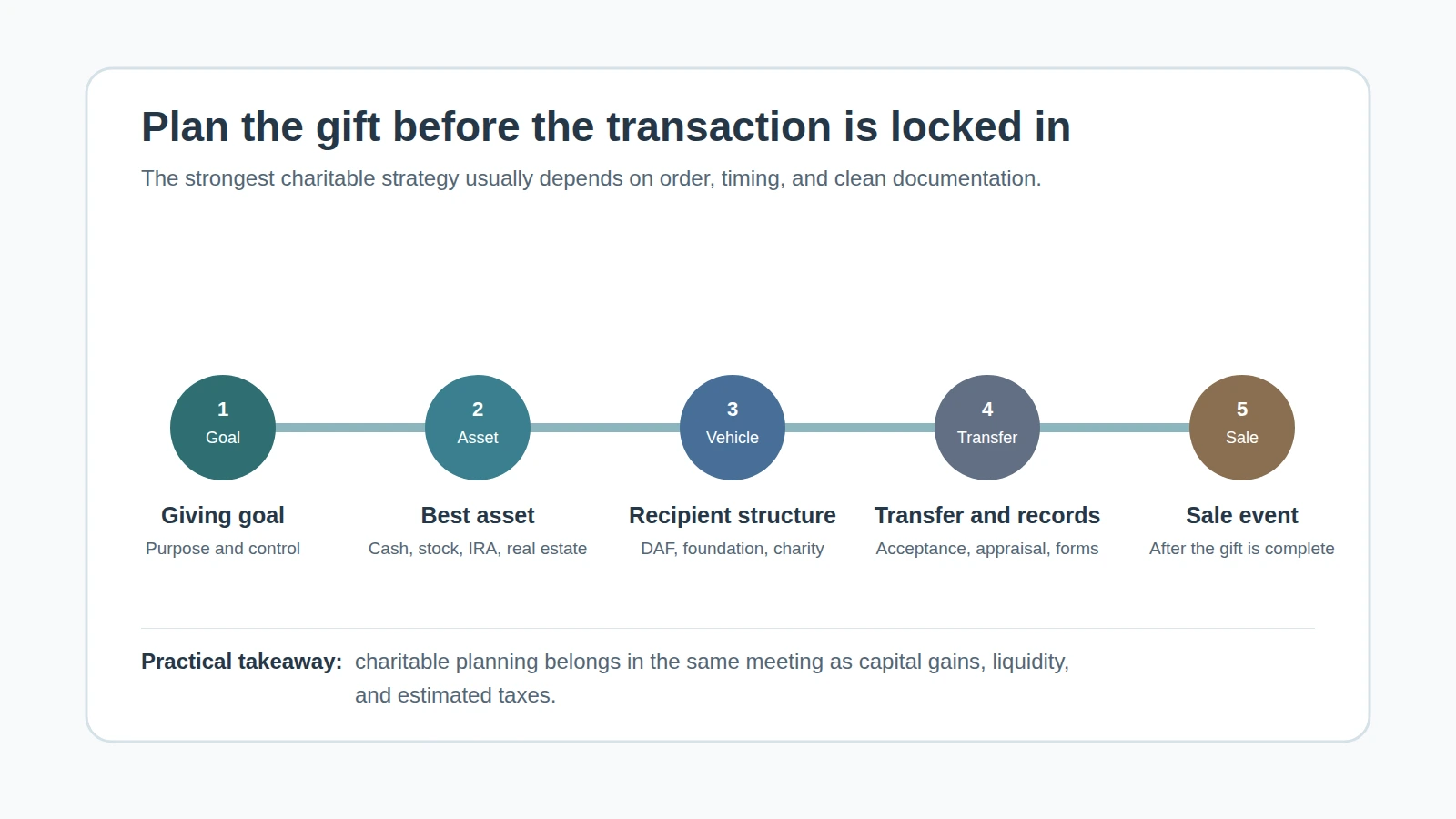
10. A practical decision order for advanced charitable planning
Start with the giving goal. Decide whether the donor wants immediate support for operating charities, a flexible charitable account, a family governance structure, or estate planning continuity.
Then identify the best asset. Cash may be fine, but appreciated securities, business interests, real estate, or IRA assets may produce a better tax result.
Next, choose the recipient structure. Direct gifts, donor-advised funds, private foundations, charitable trusts, and QCDs solve different problems.
After that, model the tax year. Review AGI, itemized deductions, capital gains, liquidity events, estimated taxes, carryforwards, and state tax treatment.
Finally, complete the paperwork before the deadline. Verify the charity’s eligibility, confirm the recipient can accept the asset, coordinate transfer instructions, obtain acknowledgments, and arrange any required appraisal.
11. When charitable planning belongs in a broader tax plan
Charitable giving should not sit in isolation when the taxpayer has a business sale, real estate gain, stock option exercise, retirement distribution, estate planning update, or unusually high-income year.
For business owners, charitable planning can interact with entity income, payroll, estimated taxes, and succession planning. For investors, it can interact with concentrated positions, capital loss harvesting, and portfolio rebalancing. For retirees, it can interact with IRA distributions and Medicare income thresholds. For families, it can interact with estate planning and multigenerational giving goals.
The best charitable plans usually do three things at once: they support the causes the donor cares about, reduce unnecessary tax friction, and leave a clean paper trail.