
What Is an Accountable Reimbursement Plan for a Corporation?
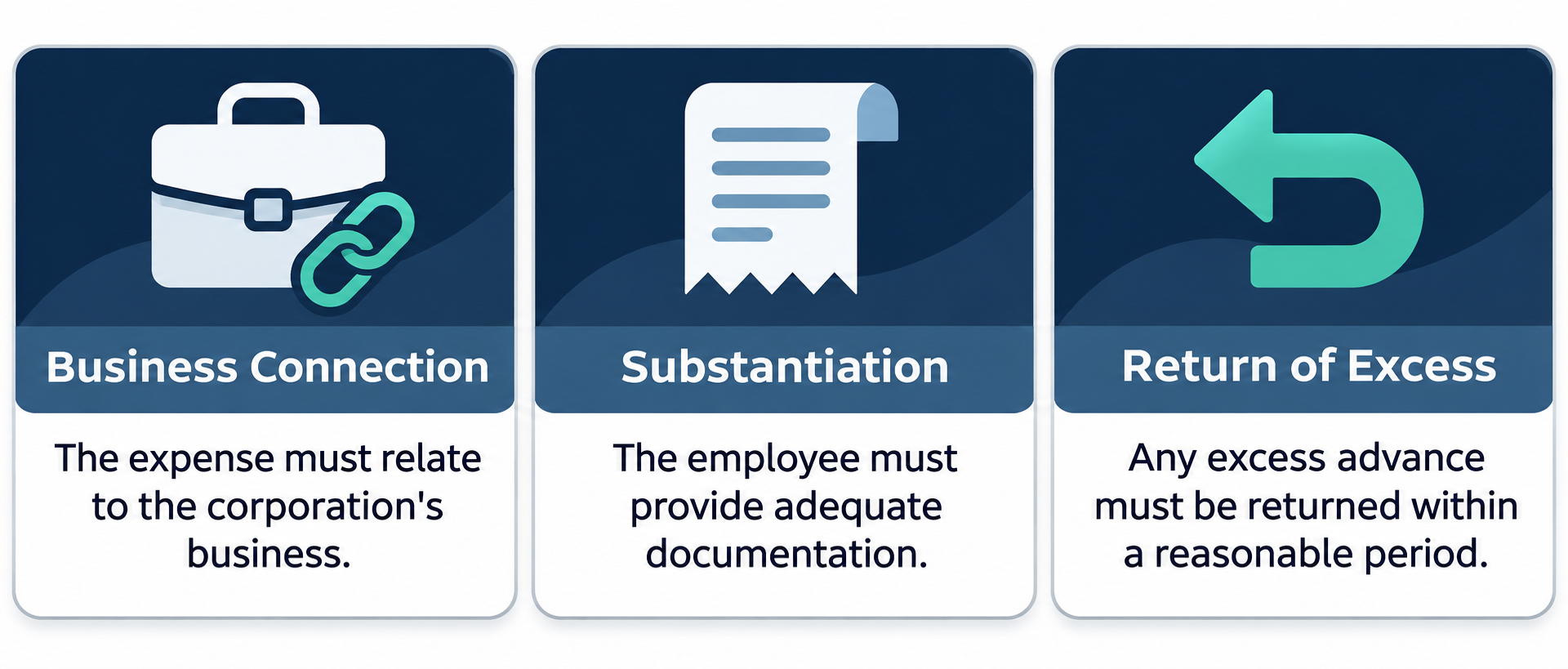
An accountable reimbursement plan is a system a corporation uses to repay employees for business expenses without treating qualifying payments as wages. To receive that federal tax treatment, the expense must relate to the corporation's business, the employee must document it within a reasonable period, and the employee must return any excess advance.
For a corporation that regularly reimburses mileage, travel, supplies, professional education, or other employee-paid costs, the plan creates a clear line between a business expense and additional compensation. It cannot turn personal spending or wages into tax-free reimbursements. The tax result follows the facts and the corporation's actual procedures.
This guide explains the three IRS accountable plan rules, the 30-, 60-, and 120-day safe harbors, payroll treatment, common reimbursable expenses, and special considerations for C corporation owners and S corporation shareholder-employees.
Accurate as of November 2026. The latest available IRS Publication 463 is the 2025 edition; IRS Publication 15 and Publication 15-B are available for 2026. Mileage and per diem rates change, and owner, home-office, medical, and state-law questions depend on the facts.
The tax result comes from following the plan in practice. Merely labeling a payment “reimbursement” does not make it tax-free.
An accountable reimbursement plan is a system under which a corporation pays or repays employees for allowable expenses they incur while performing services for the corporation. Under Treasury Regulation Section 1.62-2, the arrangement must require a business connection, adequate substantiation within a reasonable period, and return of excess payments within a reasonable period.
The central question is whether the corporation is repaying a business cost or providing additional compensation. Suppose a sales manager uses a personal vehicle to visit a customer, records the date, destination, mileage, and business purpose, and submits the log under the corporation's policy. A reimbursement based on an allowable mileage method may qualify. A recurring $500 “expense allowance” paid without mileage records or a requirement to return unsupported amounts generally does not.
An accountable plan does not make an otherwise personal or nondeductible expense deductible. It governs the tax treatment of the reimbursement. The underlying cost must still satisfy the applicable business-expense rules, and limitations can remain, for example, the corporation's deduction for qualifying business meals is generally limited even when the employee receives a tax-free reimbursement.
How an Accountable Plan Works and the Three IRS Requirements
The basic process follows the expense from purchase to approval:
- The employee incurs, or receives an advance for, a corporate business expense. The expense must relate to services performed for the corporation rather than personal activity.
- The employee submits an expense report. The report identifies the amount, date, place, business purpose, and any other required elements, with receipts or other evidence where appropriate.
- The corporation reviews the claim. An authorized reviewer confirms that the expense fits the policy, has sufficient support, and is not a duplicate or personal charge.
- The corporation reimburses and records the approved amount. Qualifying payments remain separate from taxable wages in the books and payroll records.
- The employee returns any excess advance. Unspent or unsubstantiated funds do not become a tax-free allowance merely because the corporation originally expected business spending.
Consider a hypothetical corporation that advances an employee $2,000 for a three-day customer visit. The employee later documents $1,720 of airfare, lodging, local transportation, and qualifying meal costs. The corporation approves the report, and the employee returns $280. Assuming the expenses and timing meet the applicable rules, the $1,720 can be treated as an accountable plan reimbursement rather than wages. If the employee keeps the $280 or fails to document part of the trip, the unsupported amount generally becomes taxable under the nonaccountable plan rules.
1. The expense must have a business connection
The employee must pay or incur an allowable expense while performing services as an employee of the corporation. The reimbursement must correspond to that expense and cannot replace wages the employee otherwise would have received.
The expense report must answer more than “What was purchased?” It should establish why the cost belonged to the corporation's business. A restaurant receipt shows the amount and location but not the attendees or business purpose. A mileage total without dates, destinations, and purpose does not demonstrate business use.
Corporations should define eligible categories, identify who may approve them, and prohibit personal expenses. Salary-reduction arrangements are a particular concern: a corporation generally cannot reduce an employee's wages and relabel the reduction as a reimbursement based on expenses. Payments that lack a business connection are wages, distributions, loans, or other payments depending on the facts, not accountable plan reimbursements.
2. The employee must adequately substantiate the expense
The employee must account to the corporation within a reasonable period. IRS Publication 463 describes adequate accounting as an expense statement, account book, diary, or similar contemporaneous record supported by documentary evidence such as receipts. The record generally needs the amount, time, place, and business purpose; travel, vehicle, gift, and certain other expenses have heightened substantiation rules under Internal Revenue Code Section 274(d).
The corporation should require itemized receipts rather than card slips where the details matter, a mileage log rather than an estimate, and explanations for unusual costs. Electronic expense systems are acceptable tools, but software does not cure incomplete information. The employer must receive enough support to evaluate the business nature and amount of the expense.
If an amount is not substantiated within a reasonable period, it generally falls under the nonaccountable plan rules and becomes subject to wage reporting and employment taxes. The regulation applies the tests employee by employee, so one person's failure does not automatically change properly handled payments to other employees.
3. The employee must return excess reimbursements
If an advance exceeds the substantiated expense, the employee must return the difference within a reasonable period. The advance also should be reasonably calculated not to exceed anticipated expenses.
A sound policy explains how repayment occurs, who monitors outstanding advances, and how unresolved amounts move into payroll. Regularly issuing generous advances and allowing employees to keep the balance can undermine use of the timing safe harbors, especially if the practice appears designed to avoid reporting and withholding.
The 30-, 60-, and 120-Day IRS Safe Harbors
The regulation determines a “reasonable period” from all the facts and circumstances, but it offers two safe-harbor methods. Under the fixed-date method, an action completed within the period below is treated as timely. These periods are not absolute deadlines that automatically invalidate every transaction outside them; an employer outside a safe harbor must support reasonableness based on the facts.
| Action | When the clock starts | Fixed-date safe harbor |
|---|---|---|
| Corporation gives an expense advance | The date the employee pays or incurs the anticipated expense | Advance is made within 30 days before or after that expense date |
| Employee substantiates the expense | The date the employee pays or incurs the expense | Expense is substantiated within 60 days after that date |
| Employee returns an excess advance or reimbursement | The date the employee pays or incurs the expense | Excess is returned within 120 days after that date |
The regulation also provides a periodic-statement alternative. If the corporation gives employees statements at least quarterly showing unsubstantiated advances and asks them to provide support or return the balance, an employee who does so within 120 days after the statement falls within that safe harbor.
A corporation may adopt shorter internal deadlines to close its books and keep reviews consistent. A late report should not be assumed to qualify, or to fail, without examining the circumstances and the corporation's policy.
What Expenses Can a Corporation Reimburse?
The right question is not whether an item appears on a generic list. The corporation must determine whether the employee incurred an ordinary and necessary expense for its business, whether the employee can substantiate it, and whether a special tax limitation applies.
Business mileage and vehicle costs. A corporation may use the applicable IRS standard mileage allowance or reimburse substantiated actual costs, depending on the arrangement. Commuting between home and a regular workplace is generally personal. The employee must document business miles, dates, destinations, and purpose. The rate should be checked for the year of payment rather than hard-coded into a standing policy.
Business travel. Airfare, lodging, local transportation, and certain incidental expenses may qualify when an employee travels away from the employee's tax home for the corporation's business. Personal portions of a mixed trip must be separated.
Business meals. A meal must have a business connection and meet the applicable rules. The report should identify the participants and business purpose. A qualifying accountable plan reimbursement can be excluded from the employee's wages, while the corporation generally applies the 50% deduction limit unless a statutory exception applies. Entertainment expenses are generally nondeductible even when they accompany business activity.
Office supplies and equipment. Employee-paid software, supplies, or equipment can qualify when purchased for the corporation's business and supported by receipts. Ownership, capitalization, depreciation, and return-of-property procedures may need to be addressed.
Professional development. Registration, materials, and related travel may qualify when education maintains or improves skills required in the employee's current work or meets the corporation's business needs. Education that qualifies the person for a new trade or business requires separate analysis.
Other employee business costs. Business telephone use, professional dues, shipping, and similar costs may qualify when the employee establishes the corporate purpose and allocates mixed personal and business use.
Home office reimbursements require added care. For an employee's home use to support an accountable plan reimbursement, the arrangement must satisfy the business-connection rule and the applicable home-office standards. The space generally must be used regularly and exclusively for the employer's business, and employee use must be for the employer's convenience, not merely the employee's preference. The corporation should document why the home office is needed and reimburse only a reasonable, supported allocation of actual eligible costs. The simplified home-office deduction is an individual tax-return method and should not be assumed to set the reimbursable amount. Shareholder-employees, owner-occupied property, rent paid to an owner, and depreciation or basis effects require individual review.
Accountable vs. Nonaccountable Plans
| Issue | Accountable plan | Nonaccountable plan |
|---|---|---|
| Business connection | Required | Not established or not required by the arrangement |
| Documentation | Employee must adequately substantiate expenses within a reasonable period | Payments may be made without adequate accounting |
| Excess payments | Must be returned within a reasonable period | Employee is allowed to retain excess or unsupported amounts |
| Federal payroll taxes | Qualifying amounts are not wages and are not subject to federal income tax withholding, Social Security, Medicare, or FUTA | Payments are wages and generally subject to withholding, Social Security, Medicare, and FUTA |
| Employee federal income | Qualifying reimbursements generally are not included in Form W-2 wages | Payments are generally included in Form W-2 wages |
| Employer responsibilities | Review support, recover excess, retain records, and separate reimbursements from wages | Report through payroll and satisfy wage withholding and reporting requirements |
The distinction can apply payment by payment. If an employee substantiates part of an otherwise qualifying advance but does not return the excess, the substantiated portion can remain accountable while the excess is treated as nonaccountable. IRS Publication 15 places the unsupported or unreturned amount into income and employment-tax treatment no later than the first payroll period after the reasonable period ends.
Special Considerations for S Corporations, C Corporations, and Owner-Employees
Both S corporations and C corporations can maintain accountable plans for employees, including officers who are employees. The same core requirements apply, but owner transactions deserve closer scrutiny because the owner may initiate, approve, and receive the payment.
An S corporation shareholder-employee can receive reimbursement for legitimate corporate expenses paid personally when the arrangement and payment meet the accountable plan rules. The shareholder should submit the same timely reports and evidence required of other employees; where practical, another authorized person should approve the claim. Reimbursements cannot replace reasonable compensation for services. Depending on the facts, personal bills paid by the corporation may instead be wages, distributions, or loans. Bharmal's guide to common tax mistakes business owners make explains why weak records and mixing personal and business activity create broader tax problems.
A C corporation owner-employee may likewise receive qualifying reimbursements for employee business expenses. Corporate status does not convert personal travel, commuting, clothing, housing, or family costs into corporate deductions. Related-party transactions, fringe-benefit rules, constructive dividends, and corporate formalities can change the result.
Health insurance and medical reimbursements follow separate rules. For fringe-benefit purposes, an S corporation shareholder who owns more than 2% is not treated as an employee for several exclusions. Employer-paid health benefits for that shareholder generally require special Form W-2 and individual-deduction treatment, and health reimbursement arrangements raise additional requirements. Those costs should not be folded into a general expense plan without specific analysis.
For both entity types, the safest operational principle is simple: the owner documents the expense as an employee, the corporation reviews it as a separate taxpayer, and the books distinguish wages, distributions, loans, and reimbursements.
California Reimbursement Requirements
The accountable plan rules above are federal tax rules. California employers must separately consider California Labor Code Section 2802, which generally requires an employer to reimburse necessary expenditures or losses an employee incurs as a direct consequence of performing job duties. A payment can be required under California employment law yet still need to satisfy the federal accountable plan rules to stay outside taxable wages.
A California corporation should design its policy for both tax administration and wage-and-hour compliance. An internal submission deadline helps the company collect records, but the company should not assume that a missed deadline extinguishes its state-law reimbursement obligation. Remote-work costs, personal device use, mileage methods, and deductions or offsets involving wages can require California employment-law analysis.
Common Mistakes and How to Establish an Accountable Plan
Common failures include relying on bank or card statements without itemized support, treating personal expenses as corporate costs, and paying flat allowances without the required accounting. A statement proves that money changed hands, but not what was purchased or why it served the corporation. Personal travel, commuting, family meals, and mixed-use purchases do not become business expenses simply because an owner approves them.
Corporations should also avoid mixing wages with reimbursements, leaving advances unresolved, applying looser standards to owner-employees, or failing to retain records. Unsupported advances can become taxable wages. The corporation should maintain expense reports, receipts, mileage logs, approvals, repayment records, and the related accounting entries.
A practical setup follows these steps:
Adopt a written policy. Federal accountable plan status does not generally depend on a document bearing a particular title, but a written business expense reimbursement policy is the clearest way to define the rules and support consistent accounting. Identify the corporation, eligible employees, effective date, administrator, and approval authority.
Define eligible and excluded expenses. List the common categories and explain that every claim still needs a corporate business purpose. Address commuting, mixed personal use, travel companions, alcohol, entertainment, upgrades, capital equipment, and other areas likely to cause confusion.
Specify documentation standards. Require the date, amount, vendor or destination, business purpose, participants where relevant, and itemized receipts. For vehicles, require a contemporaneous mileage log with business miles and destinations. Build special Section 274 substantiation into the form.
Set submission and review procedures. Choose practical internal deadlines, ideally within the IRS safe-harbor periods. State who reviews employee claims, who reviews owner or executive claims, and how rejected or incomplete reports are corrected.
Control advances and excess reimbursements. Limit advances to reasonably anticipated costs. Track each advance against the related report, require prompt repayment of the excess, and use quarterly statements if the corporation relies on the periodic-statement safe harbor.
Coordinate accounting and payroll. Post approved reimbursements to the correct expense or asset accounts, not wage expense. Create a documented process for moving unsupported or unreturned amounts into payroll at the correct time. This is where coordinated business accounting and payroll procedures matter.
Train employees and retain records. Give employees examples of acceptable reports and explain that a receipt without a business purpose may be insufficient. Store reports, evidence, approvals, and repayments so the corporation can support both its deduction and payroll treatment.
Review the plan periodically. Update mileage and per diem rates, expense categories, remote-work practices, approval assignments, and payroll procedures. Test a sample of owner and employee claims to confirm that actual practice matches the policy, and include the result in the corporation's broader year-end tax planning.
How Bharmal CPA Can Help
Bharmal CPA can help business owners review how an accountable reimbursement plan fits with the corporation’s tax planning, accounting, and payroll processes. If your corporation is establishing a plan or correcting an inconsistent process, contact Bharmal CPA to discuss the facts and the areas that need professional review.
Frequently Asked Questions
Are accountable plan reimbursements taxable to employees?
Generally, no, if the reimbursement satisfies all accountable plan requirements. A qualifying payment is not treated as federal wages and generally is not reported in Form W-2 box 1. Unsupported amounts and excess payments not returned within a reasonable period are generally taxable wages.
Does a corporation need a written accountable plan?
Federal rules generally focus on how the arrangement operates, not whether it has a particular written plan document. A written policy is nevertheless strongly recommended because it defines eligible expenses, evidence, deadlines, approvals, repayment requirements, and payroll treatment.
Can an S corporation shareholder reimburse themselves for business expenses?
A shareholder-employee may receive reimbursement for legitimate S corporation business expenses, but should not simply transfer money without documentation. The shareholder should submit an expense report, substantiate the expense, return any excess, and maintain separation between wages, distributions, loans, and reimbursements.
Can a corporation reimburse an employee for home office expenses?
Potentially, but not simply because the employee works remotely. The space generally must be used regularly and exclusively for the employer's business and for the employer's convenience. The corporation also needs a reasonable allocation method and supporting records. Owner-employees, rent arrangements, and property-basis issues require specific review.
Are mileage reimbursements taxable?
They generally are not taxable when paid under a qualifying accountable arrangement at an allowable rate and supported by business-mile records. Commuting is generally personal, and an allowance above the deemed substantiated amount can create taxable wages for the excess.
What happens if an employee does not submit receipts?
The corporation should determine whether another form of evidence satisfies the applicable substantiation rule. If the employee does not adequately account within a reasonable period, the unsupported reimbursement generally becomes taxable under the nonaccountable plan rules. A missing receipt affidavit should not become a routine substitute for records.
Can a corporation reimburse business meals?
Yes, when the meal has a qualifying business connection and is adequately documented. Tax-free treatment to the employee does not mean a full employer deduction; the corporation generally remains subject to the applicable meal deduction limitation.
What is the difference between an accountable and a nonaccountable plan?
An accountable plan requires a business connection, adequate substantiation, and return of excess payments. Qualifying payments are excluded from federal wages. Nonaccountable plan payments are generally wages subject to income tax withholding and employment taxes.
How long does an employee have to submit expenses?
The employee must submit them within a reasonable period based on the facts. Substantiation within 60 days after payment or incurrence falls within the IRS fixed-date safe harbor. A corporation may use a shorter policy deadline; a later report is not automatically unreasonable, but it requires facts-and-circumstances analysis.
Can a corporation adopt an accountable plan after expenses have been incurred?
Possibly, if the expense had a genuine corporate business connection and is substantiated and reimbursed within a reasonable period. The corporation should not backdate a policy or use it to recharacterize wages, distributions, or stale personal spending. Historical expenses require transaction-by-transaction review.